Every business generates financial activity.
Customers pay invoices. Bills need to be paid. Money moves through bank accounts and credit cards. Equipment is purchased. Loans are received and repaid. Owners invest or withdraw money. Employees and contractors are paid.
Bookkeeping is the process of recording, organizing, and maintaining that financial activity so your company’s books accurately reflect what happened in the business.
Good bookkeeping isn’t simply about entering transactions into QuickBooks.
It’s about recording those transactions correctly and consistently so the financial information produced from your books is useful.
What Does a Bookkeeper Actually Do?
A bookkeeper helps maintain the financial records of a company.
Depending on the business, bookkeeping may include:
- Recording and categorizing transactions
- Reconciling bank and credit card accounts
- Recording customer invoices and payments
- Tracking Accounts Receivable
- Recording bills and vendor payments
- Tracking Accounts Payable
- Recording loans and loan payments
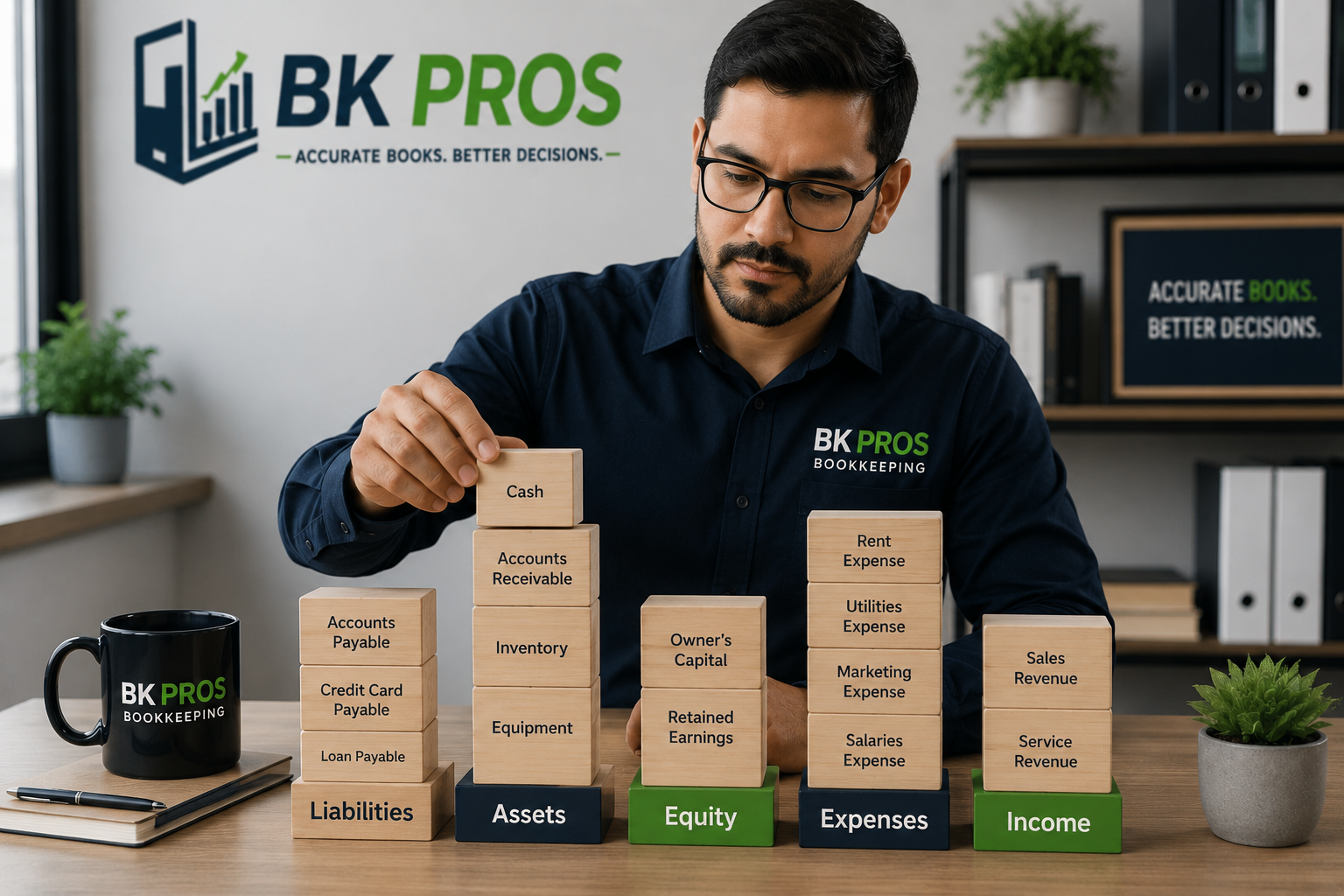
- Categorizing assets and liabilities
- Reviewing owner contributions and distributions
- Maintaining the Chart of Accounts
- Reviewing unusual or duplicate transactions
- Preparing financial reports
- Keeping the books organized for the CPA or tax professional
The objective is not simply to put every transaction somewhere in QuickBooks.
The objective is to put each transaction where it belongs.
Bookkeeping Is the Foundation of Your Financial Reports
Two of the most important reports generated from your bookkeeping are the:
Profit & Loss
and
Balance Sheet
Your Profit & Loss helps show the company’s income and expenses over a period of time.
Your Balance Sheet shows the company’s assets, liabilities, and equity at a specific point in time.
But these reports are only as reliable as the information used to create them.
If transactions are duplicated, missing, or incorrectly categorized, the financial reports can also become misleading.
Accurate reports start with accurate bookkeeping.
Categorizing Transactions Is Only Part of Bookkeeping
Bank feeds have made it much easier to bring transactions into QuickBooks Online.
But downloading a transaction from your bank doesn’t automatically mean it has been recorded correctly.
Imagine your company receives $25,000 from a bank loan.
The money enters the checking account, but that doesn’t make it Income.
The company received cash, but it also created an obligation to repay the lender.
Similarly, if an owner contributes $10,000 to the company, that deposit generally shouldn’t simply be treated as sales income.
This is why bookkeeping requires more than looking at whether money came in or went out.
You need to determine what the transaction actually represents.
Reconciliation Is a Critical Part of Bookkeeping
One of the most important bookkeeping processes is reconciling your financial accounts.
A reconciliation compares the transactions recorded in QuickBooks with the transactions reported by the bank or credit card company for the same statement period.
The goal is to verify that the financial activity recorded in your books can be supported by the underlying financial statements.
Reconciliation can help identify:
- Missing transactions
- Duplicate transactions
- Incorrect amounts
- Transactions recorded in the wrong account
- Changes to previously reconciled activity
- Other bookkeeping discrepancies
Reaching a $0.00 reconciliation difference is important, but the process is about more than simply reaching zero.
It’s about verifying that the books accurately reflect the underlying activity.
What Happens When Bookkeeping Isn't Maintained?
Bookkeeping problems don’t always become obvious immediately.
A duplicate transaction today may seem insignificant.
But if similar problems continue for months or years, they can accumulate.
Eventually, you may discover:
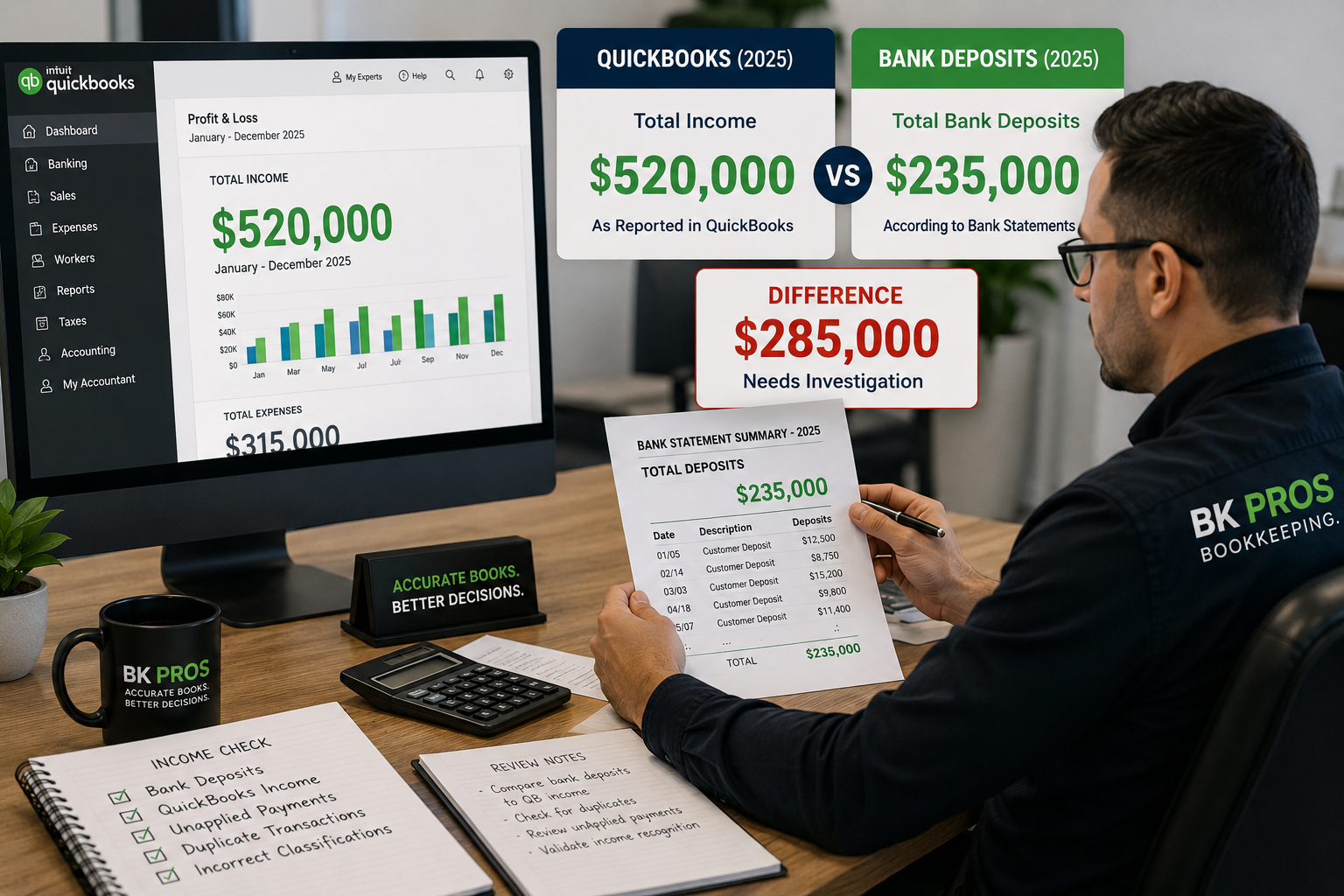
- QuickBooks doesn’t match the bank
- Income appears higher or lower than expected
- Accounts Receivable contains old balances
- Accounts Payable doesn’t accurately reflect what you owe
- Unapplied Cash Payment Income appears on the Profit & Loss
- Duplicate transactions have accumulated
- Accounts haven’t been reconciled for months
- The Chart of Accounts has become disorganized
- Financial reports no longer make sense
These problems often become especially noticeable when financial statements are needed or when it’s time to prepare information for your CPA or tax professional.
Bookkeeper vs. CPA: Different Roles
A bookkeeper and a CPA may work with the same financial information, but their roles are not necessarily the same.
A bookkeeper generally focuses on maintaining and organizing the company’s day-to-day financial records.
The bookkeeper helps make sure transactions are properly recorded, accounts are reconciled, and the books are organized.
A CPA or tax professional may then use those records for services such as tax preparation, tax planning, financial analysis, or other accounting work depending on their engagement.
One way to think about it is:
The bookkeeper helps build and maintain the financial records.
The CPA or tax professional can then work from those records for the services they provide.
That’s one reason clean bookkeeping can be so valuable before tax preparation begins.
QuickBooks Is a Tool — The Books Still Need to Be Managed
QuickBooks Online can automate many tasks, connect to financial institutions, download transactions, generate reports, and help organize financial information.
But QuickBooks doesn’t independently know the complete business purpose behind every transaction.
A $5,000 payment could be:
- Rent
- Equipment
- A loan payment
- An owner distribution
- Inventory
- A vendor payment
- A transfer between accounts
The amount alone doesn’t determine how it should be recorded.
QuickBooks provides the tools. Good bookkeeping provides the structure and judgment needed to use those tools correctly.
Why Good Bookkeeping Matters
Accurate bookkeeping gives business owners better information about what’s happening inside their company.
It can help you:
- Review income and expenses
- Monitor cash and account balances
- Understand what customers owe you
- Track what you owe vendors and lenders
- Identify unusual financial activity
- Produce more reliable financial reports
- Prepare organized records for your CPA or tax professional
Most importantly, good bookkeeping gives you greater confidence that the numbers you’re looking at actually represent the financial activity of your company.
Are Your Books Telling the Right Story?
BK PROS helps business owners organize, maintain, and review their QuickBooks Online records.
Whether your books need ongoing bookkeeping or you already suspect there may be duplicate transactions, reconciliation problems, incorrect balances, or other bookkeeping issues, the first step is determining what’s actually happening inside the file.
Not sure whether your QuickBooks file is accurate?
Get Your Books Reviewed.