
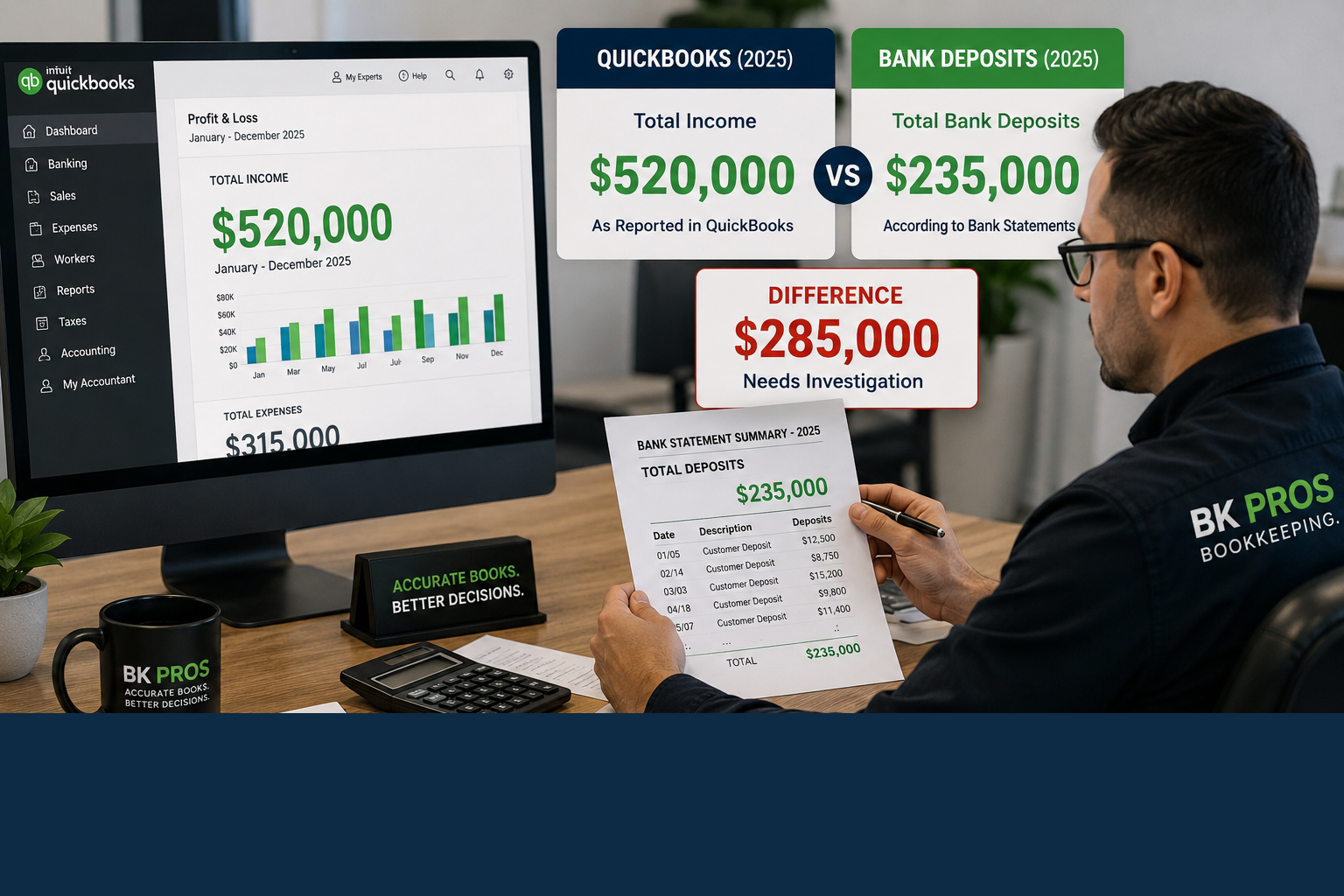
Your Profit & Loss may show $520,000 in income—but does that mean your business actually received $520,000?
Not necessarily.
One of the first things we look at when reviewing a QuickBooks file is whether the income reported in QuickBooks makes sense compared with the actual deposits recorded by the bank.
A significant difference doesn’t automatically mean your books are wrong. Timing differences, outstanding Accounts Receivable, transfers, and accounting method can all affect the numbers. But a large unexplained difference deserves investigation.
Compare QuickBooks With What Actually Reached the Bank
Instead of simply trusting the Profit & Loss total, we can review the bank statements for the same period and calculate the deposits that actually reached the company’s bank accounts.
For example:
QuickBooks Income for 2025: $520,000
Bank Deposits for 2025: $235,000
Difference: $285,000
That $285,000 difference doesn’t immediately tell us what is wrong. It tells us where to start looking.
Where Can the Difference Come From?
✓ Duplicate income transactions
✓ Sales recorded more than once
✓ Deposits incorrectly categorized as income
✓ Transfers recorded as income
✓ Customer payments duplicated through the bank feed
✓ Accounts Receivable or timing differences
✓ Cash vs. accrual reporting differences
✓ Other incorrectly classified transactions
How BK Pros Investigates the Difference
1. Start With the Bank Statements
We review the bank statements for the period and calculate the actual deposits recorded by the bank. For a full-year review, this means analyzing the deposits month by month to establish an independent total for the year.
2. Compare the Bank Activity With QuickBooks
We run a Transaction Detail by Account report for the same period and analyze the activity recorded in QuickBooks. We can then analyze the relevant debits and credits and compare the QuickBooks activity with the underlying bank activity to help identify where the discrepancy may be coming from.
3. Review Cash and Accrual Reports
We compare the results under both cash and accrual accounting methods. This can help identify whether Accounts Receivable, payment activity, or timing differences explain part of the discrepancy.
4. Investigate the Difference
When the numbers don’t make sense, we look deeper for duplicate transactions, incorrectly categorized deposits, transfers recorded as income, duplicated customer payments, and other bookkeeping issues that may be affecting the financial statements.
The goal isn’t to make QuickBooks match the bank blindly. The goal is to explain why the numbers are different.
Why This Matters
When income is overstated in QuickBooks, your Profit & Loss may present a very different picture of your company’s actual financial performance.
Inaccurate financial records can affect business decisions, financial reporting, and the information you provide to your CPA or tax professional.
Finding the discrepancy is only the first step. The important part is identifying what caused it and determining what needs to be corrected.
Not Sure If Your QuickBooks Income Is Accurate?
BK Pros can review your QuickBooks file and help identify discrepancies, duplicate transactions, reconciliation issues, and other signs that your books may need cleanup.