Your company buys a $25 printer cartridge and a $25,000 vehicle.
Money left the bank account in both cases.
But should both transactions be categorized as expenses?
Not necessarily.
One of the most important parts of bookkeeping is identifying what a transaction actually represents, not simply whether money came in or went out.
Some purchases represent costs of operating the business during the current period. Others may represent assets that provide value beyond the current period.
Categorizing these transactions incorrectly can affect both your Profit & Loss and your Balance Sheet.
What Is an Expense?
An expense generally represents a cost incurred in operating the business.
Common examples may include:
- Rent
- Utilities
- Advertising
- Insurance
- Office supplies
- Professional services
- Repairs and maintenance
- Payroll-related expenses
- Telephone and internet
- Software subscriptions
Expenses generally appear on the Profit & Loss and reduce the company’s reported profit for the period.
But just because the company paid for something doesn’t automatically mean it belongs in an expense account.
What Is an Asset?
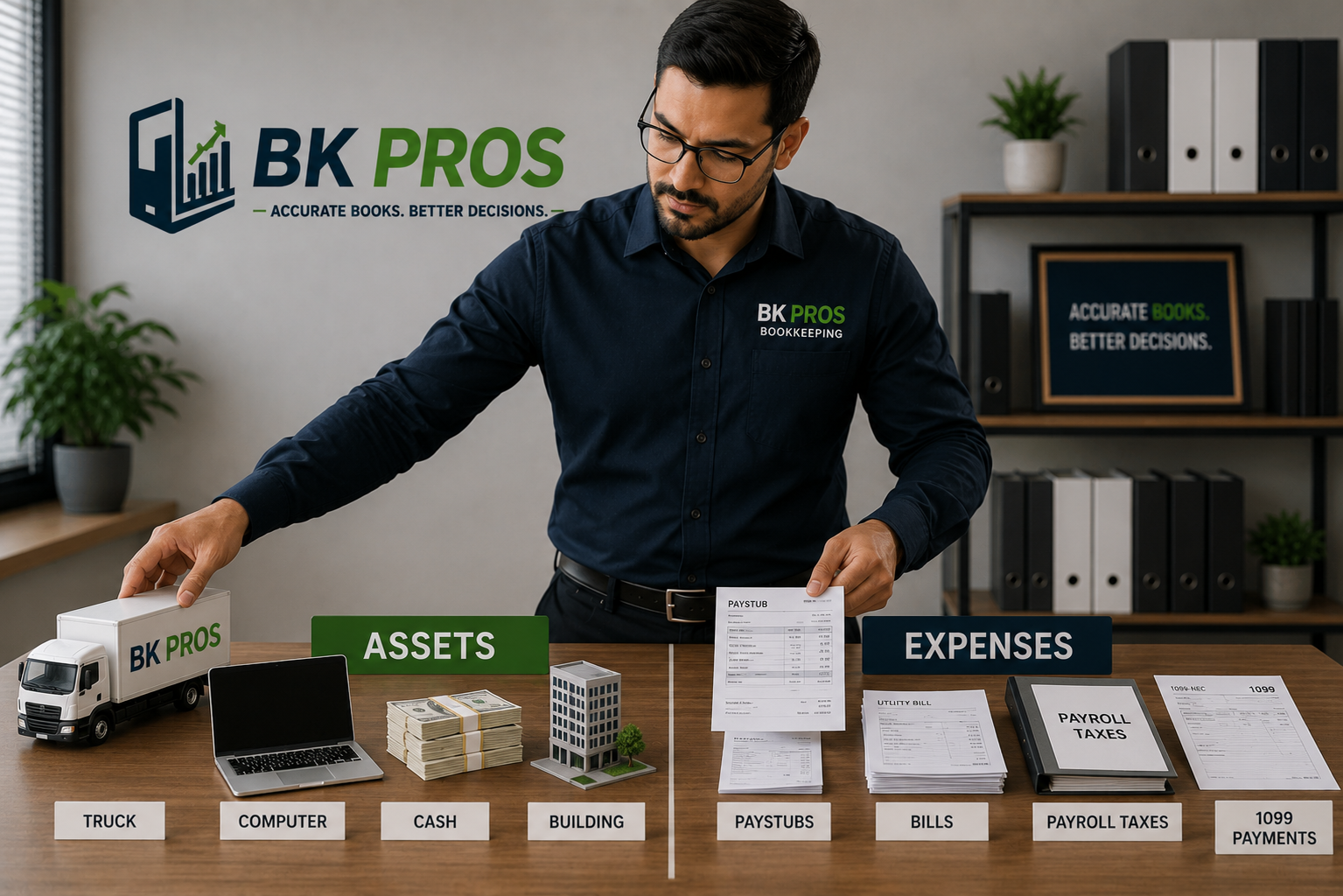
An asset is something the company owns or controls that provides economic value.
Depending on the business, assets may include:
- Cash
- Accounts Receivable
- Inventory
- Vehicles
- Machinery
- Computers and equipment
- Furniture
- Buildings
- Land
- Prepaid expenses
- Other business property
Assets generally appear on the Balance Sheet, rather than being immediately presented as operating expenses on the Profit & Loss.
Expense or Asset? Consider What Was Purchased
Imagine your company makes these two purchases:
Office Supplies: $150
and
Computer Equipment: $5,000
Both required money to leave the company’s bank account.
But they don’t necessarily represent the same type of transaction.
The office supplies may represent a normal operating expense.
The computer may represent equipment that will be used by the business beyond the current period and could potentially need to be recorded as an asset, depending on the company’s accounting policies and applicable tax/accounting treatment.
The important question isn’t:
“Did we spend money?”
It’s:
“What did the company receive in exchange for that money?”
A Large Purchase Isn't Automatically an Asset
Price alone doesn’t determine whether something should be categorized as an asset.
The nature of the purchase matters.
For example, a company might spend:
$8,000 on advertising
That is a significant amount of money, but the size of the payment alone doesn’t mean you should create an $8,000 fixed asset.
Likewise, a relatively inexpensive piece of equipment isn’t necessarily treated as a fixed asset simply because it is physical property.
Accounting policies, capitalization thresholds, useful life, materiality, and applicable tax rules can affect the appropriate treatment.
When necessary, your CPA or tax professional can help determine the appropriate capitalization and tax treatment for significant purchases.
Don't Automatically Categorize Equipment as an Expense
Suppose your construction company purchases a truck for:
$45,000
If the entire transaction is categorized to an ordinary vehicle expense account, your Profit & Loss may immediately reflect a $45,000 expense even though the company acquired a vehicle it expects to use over multiple periods.
That can distort how the transaction is presented in the financial statements.
The purchase may need to be recorded as an asset, while depreciation and other related costs are handled separately according to the appropriate accounting and tax treatment.
The same concern can apply to purchases such as:
- Machinery
- Computers
- Furniture
- Large equipment
- Buildings
- Other long-term business property
But Don't Put Every Purchase Into Fixed Assets Either
The opposite mistake can also happen.
A QuickBooks file may contain ordinary purchases sitting in Fixed Assets simply because someone assumed:
“We bought something, so it must be an asset.”
That can create an inflated Balance Sheet and keep ordinary operating costs from appearing where they belong on the Profit & Loss.
For example, routine office supplies, repairs, subscriptions, utilities, and similar operating costs generally shouldn’t be placed into Fixed Assets simply because the company paid for them.
Not every purchase is an expense—and not every purchase is an asset.
What About Smaller Equipment Purchases?
This is an area where bookkeeping and tax treatment can overlap.
For U.S. businesses, tax rules may allow certain qualifying purchases below specified thresholds to be expensed rather than capitalized when the applicable requirements are met.
One commonly discussed provision is the IRS de minimis safe harbor for tangible property.
However, whether a particular purchase qualifies—and how the business should apply the election—is a tax question that can depend on the company’s circumstances and accounting procedures.
For bookkeeping purposes, it can be helpful to consistently identify these purchases so they can be reviewed appropriately.
Your CPA or tax professional should determine the tax treatment applicable to your company.
Loans Are Another Good Example
Suppose your company purchases a $40,000 vehicle and finances most of the purchase.
This transaction can involve several accounting components:
- Vehicle → potentially an Asset
- Loan → Liability
- Cash down payment → reduction of Cash
- Interest paid over time → potentially Interest Expense
Simply categorizing every future loan payment as Vehicle Expense can therefore misrepresent what is happening.
Part of the payment may reduce the loan principal, while another portion may represent interest.
One payment can affect several accounts.
Why Incorrect Classification Matters
Imagine a company purchases $100,000 of equipment during the year and incorrectly categorizes all of it as ordinary operating expenses.
The Profit & Loss may show significantly higher expenses than it otherwise would.
Now imagine the opposite problem: ordinary operating expenses are incorrectly placed into asset accounts.
The Profit & Loss may show expenses that are too low, while the Balance Sheet may contain assets that shouldn’t be there.
Either way, the financial statements can become misleading.
This is why correct classification matters.
Review Both the Profit & Loss and Balance Sheet
When reviewing your books, don’t look at the Profit & Loss in isolation.
Review the Balance Sheet too.
Ask:
Do the Fixed Assets make sense?
Are vehicles and equipment actually owned by the company?
Are there unusually large purchases sitting in ordinary expense accounts?
Are normal operating expenses sitting in asset accounts?
Do loan balances reasonably reflect what the company owes?
Unusual balances don’t automatically mean something is wrong.
But they can tell you where to investigate.
Don't Reclassify Transactions Based Only on the Amount
A $10,000 transaction deserves attention because it is significant.
But the amount doesn’t tell you what the transaction represents.
It could be:
- Equipment
- Rent
- Advertising
- Inventory
- A loan payment
- A prepaid expense
- A vendor deposit
- An owner distribution
- Something else entirely
Before changing the category, determine the business purpose and substance of the transaction.
Supporting documentation such as invoices, receipts, purchase agreements, loan documents, and bank statements can help establish what actually occurred.
Correct Classification Creates Better Financial Reports
The purpose of categorizing transactions isn’t simply to keep QuickBooks organized.
Classification determines where financial activity appears on your reports.
Expenses affect the Profit & Loss.
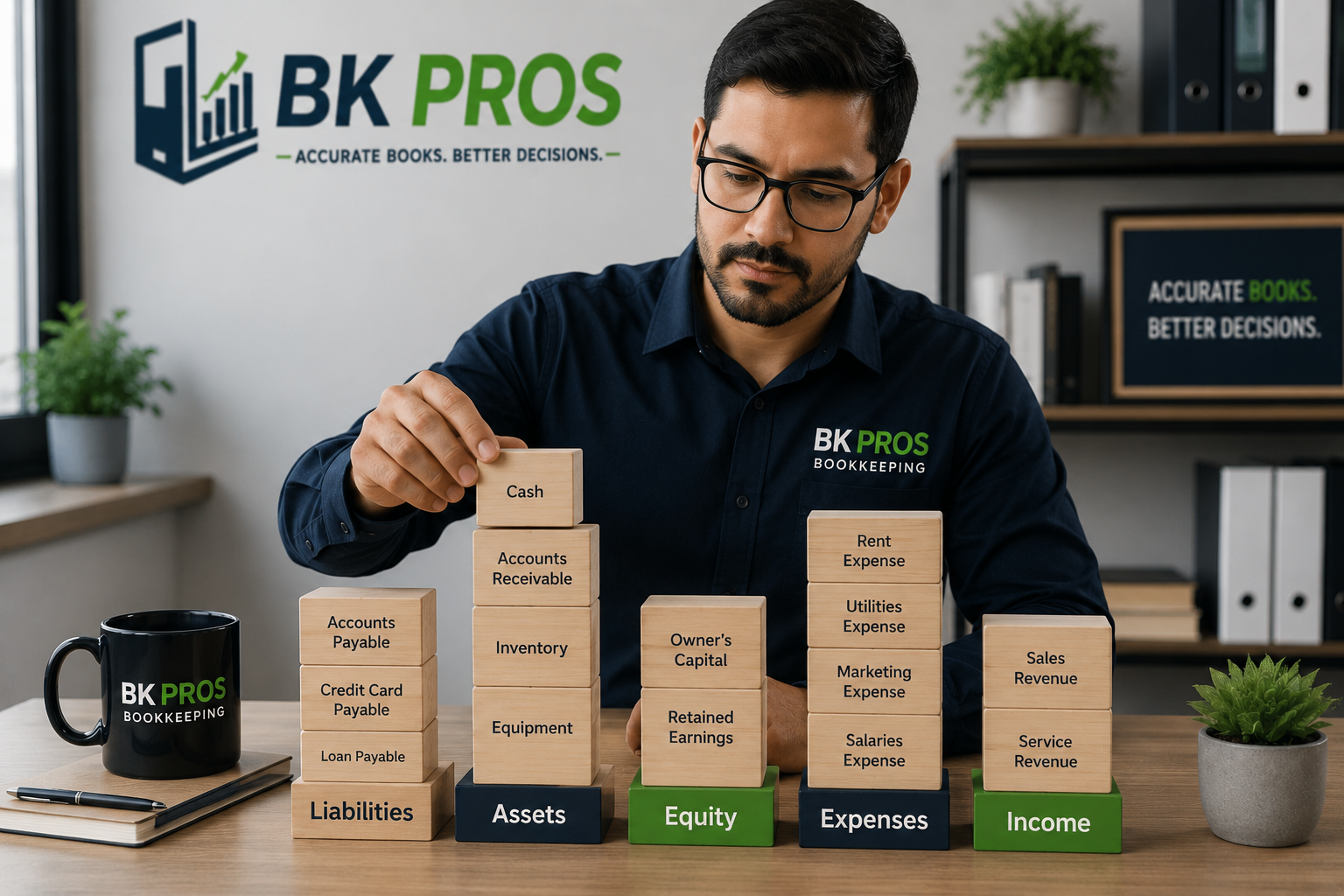
Assets generally appear on the Balance Sheet.
Liabilities, equity, income, and other account types each have their own role.
Putting a transaction into the wrong category can therefore change the financial picture presented by QuickBooks.
Accurate financial reports start with accurate classification.
Not Sure Whether Your Purchases Are Categorized Correctly?
BK PROS can review your QuickBooks file and help identify unusual asset balances, large purchases recorded as expenses, operating expenses recorded as assets, loan activity, reconciliation issues, and other bookkeeping discrepancies.
When accounting or tax treatment requires professional tax judgment, we can also help keep the underlying bookkeeping organized for your CPA or tax professional.
Not sure whether your transactions are classified correctly?
Get Your Books Reviewed.